How to Build a Curriculum Map for Private Language Students
A practical guide to planning long-term learning paths for 1:1 language students. Covers CEFR-based progression, backward design, skill rotation, and templates for independent language teachers.
You know how to teach a great individual lesson. You can explain the past tense, run a conversation activity, correct errors in real time.
But zoom out to six months. What’s the plan? What should your B1 student be working on in Month 3? How do you know when they’re ready for B2 material?
Most independent language teachers don’t have a curriculum map. They wing it lesson by lesson, picking topics based on what feels right. It works for a while, but eventually students sense the lack of direction, and that’s when they start to disengage.
Why Private Tutors Need a Curriculum Map
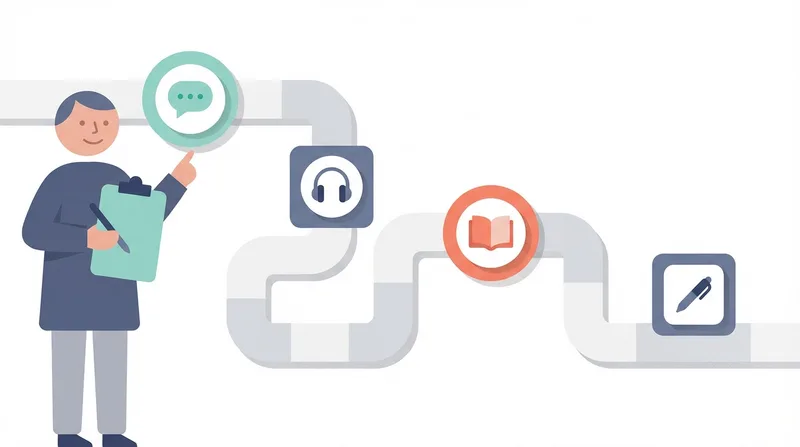
A curriculum map is not a rigid syllabus. It’s a flexible plan that answers three questions:
- Where is this student now? (current level across skills)
- Where do they want to be? (their goal)
- What’s the path between those two points?
Without this, lessons become reactive. You teach whatever comes up. The student enjoys it in the moment but after 3 months can’t articulate what they’ve learned.
With a curriculum map:
- Students see progress (even during the intermediate plateau)
- You spend less time planning individual lessons (the map guides your choices)
- You can spot gaps before they become problems
- You look more professional than 90% of independent teachers
The CEFR Framework (Quick Reference)
The Common European Framework of Reference for Languages (CEFR) provides the foundation for most curriculum planning. Here’s what each level means in practical terms:
A1 (Beginner): Can introduce themselves, ask/answer basic personal questions, understand slow speech.
A2 (Elementary): Can handle routine social exchanges, describe their background, understand sentences about familiar topics.
B1 (Intermediate): Can deal with most travel situations, describe experiences and events, give reasons for opinions.
B2 (Upper-Intermediate): Can interact fluently with native speakers, understand complex text on familiar topics, produce detailed writing.
C1 (Advanced): Can express ideas fluently without searching for words, use language flexibly for social/academic/professional purposes.
C2 (Mastery): Can understand virtually everything heard or read, summarize and reconstruct arguments coherently.
How Long Each Level Takes (Private Tutoring)
Cambridge English’s Guided Learning Hours data, adapted for 1:1 private tutoring:
| Transition | Classroom Hours | Private Tutoring Estimate |
|---|---|---|
| Zero to A1 | 90-100 hours | 60-80 hours |
| A1 to A2 | ~100 hours | 70-90 hours |
| A2 to B1 | ~200 hours | 140-170 hours |
| B1 to B2 | ~200 hours | 150-180 hours |
| B2 to C1 | ~200 hours | 160-200 hours |
| C1 to C2 | 300-400 hours | 250-350 hours |
Private tutoring is more efficient than classroom teaching because of the 1:1 attention. But the B1-to-B2 transition often takes longer than expected due to the “intermediate plateau” where progress feels invisible.
Key insight: At 2 lessons per week (1.5 hours each), moving from A2 to B1 takes roughly 11-14 months. Set realistic expectations with students from the start.
Three Approaches to Building Your Map
Approach 1: Backward Design
Start with the end goal and work backward.
Step 1: Define the destination. Ask your student: “What do you want to be able to do?” Not “what level do you want to reach” but specifically what they want to do with the language.
Examples:
- “Have meetings with German-speaking clients” (B2 Speaking + Business vocabulary)
- “Pass the DELE B2 exam by December” (B2 all skills, exam-specific strategies)
- “Travel independently in Japan” (A2-B1 Speaking + Listening, travel vocabulary)
Step 2: Identify the skills needed. Break the goal into specific abilities:
- Business meetings: formal register, expressing disagreement politely, presenting data, understanding fast speech
- DELE B2: reading comprehension strategies, essay structure, listening for detail, oral exam format
- Travel: ordering food, asking directions, handling emergencies, making small talk
Step 3: Assess current level. For each skill, note where the student is now. Use the first 1-2 lessons as an informal assessment:
- Speaking: Can express opinions but struggles with supporting arguments (B1)
- Listening: Understands clear speech but loses thread in natural conversations (A2+)
- Reading: Good comprehension of adapted texts, struggles with authentic articles (B1)
- Writing: Can write short messages but not structured paragraphs (A2+)
Step 4: Map the gap. Between “now” and “goal,” list the specific skills to develop. Group them into monthly themes.
Example for a B1 student targeting B2 Business English:
| Month | Theme | Key Skills |
|---|---|---|
| 1 | Workplace basics | Describing your job, company vocabulary, formal email structure |
| 2 | Meetings | Expressing opinions, agreeing/disagreeing, taking turns |
| 3 | Presentations | Structuring an argument, data vocabulary, transitions |
| 4 | Negotiations | Conditional structures, softening language, proposals |
| 5 | Review + gaps | Mock meeting, identify weak areas, targeted practice |
| 6 | Fluency push | Speed drills, authentic listening, spontaneous discussion |
Approach 2: The 4-Skill Rotation
For students without a specific goal (they just want to “improve”), use a balanced rotation across the four language skills.
4-Week Cycle:
Week 1: Speaking Focus
- Main activity: Extended conversation or role-play
- Grammar: Speaking-relevant structures (question forms, connectors)
- Homework: Record a 2-minute voice message on a topic
Week 2: Listening Focus
- Main activity: Authentic audio/video with comprehension tasks
- Vocabulary: Pre-teach key words from the listening material
- Homework: Watch a short video, summarize key points
Week 3: Reading Focus
- Main activity: Article or story with guided comprehension
- Grammar: Structures observed in the text
- Homework: Read a related article, highlight 5 new words
Week 4: Writing Focus
- Main activity: Structured writing task (email, paragraph, short essay)
- Grammar: Writing-relevant structures (formal register, linking words)
- Homework: Write a second draft incorporating corrections
Assessment: Every 4th cycle (every 16 weeks)
- 10-minute speaking test (compare to previous recording)
- Short reading comprehension
- Brief writing task
- Review progress and adjust the map
Approach 3: Theme-Based Progression
Organize your curriculum around real-life themes, progressing from simple to complex within each topic area.
A2 Level Example (6 months):
| Month | Theme | Grammar | Vocabulary |
|---|---|---|---|
| 1 | Daily Life | Present simple/continuous | Routines, home, family |
| 2 | Food & Social | Count/uncount, some/any | Restaurant, cooking, social phrases |
| 3 | Travel | Past simple | Transport, accommodation, directions |
| 4 | Health & Body | Modal verbs (should, must) | Body parts, symptoms, advice |
| 5 | Work & Study | Future forms (will, going to) | Jobs, workplace, education |
| 6 | Review & Stories | Mixed tenses | Narrative vocabulary, sequencing |
Each month has a clear theme that students can relate to. Grammar and vocabulary serve the theme rather than being taught in isolation.
The Needs Analysis (First Lesson Template)
Your curriculum map starts with data. Use the first lesson (or first 15 minutes) to gather this information:
Questions to Ask
Background:
- What languages do you speak? (transfer from L1 affects learning path)
- How long have you been learning this language?
- Have you taken classes before? What worked/didn’t work?
Goals:
- Why are you learning? (work, travel, family, exam, hobby)
- What’s your timeline? (exam date, trip date, or open-ended)
- What frustrates you most about your current level?
Self-Assessment:
- Which skill feels strongest? (speaking, listening, reading, writing)
- Which feels weakest?
- Can you have a conversation about familiar topics? (calibration question)
Logistics:
- How many hours per week can you study outside of lessons?
- Do you prefer homework or independent study?
- Any learning preferences? (visual, audio, text-based)
What to Do With This Data
After the needs analysis, spend 15 minutes mapping a rough 3-month plan. Share it with the student:
“Based on what you’ve told me, here’s what I’d suggest for the next 3 months. Month 1: [theme]. Month 2: [theme]. Month 3: [theme]. After that, we’ll reassess and adjust. Does this feel right?”
Students appreciate seeing a plan. It signals professionalism and builds trust.
Keeping the Map Updated
A curriculum map that never changes is useless. Review and adjust:
- After every 4 lessons: Are we on track? Any topics taking longer than expected?
- Monthly: Update the plan based on what you’ve covered and what needs more work
- Quarterly: Formal reassessment. Compare current performance to where the student started.
Teeachie’s learning path feature lets you create milestone-based progress trackers with templates. Students can see their own progress, and you can link specific classes and notes to milestones as evidence of what they’ve achieved.
Common Mistakes
1. Planning too far ahead. A 12-month curriculum map for a new student is a guess. Plan 3 months in detail, sketch the next 3 months loosely, and don’t plan beyond 6 months.
2. Ignoring student interests. A student who loves football will engage more with football-themed content than generic textbook topics. Weave their interests into your themes.
3. Treating all skills equally when they’re not. If a student needs B2 Speaking for work but is fine with A2 Writing, don’t spend equal time on both. Weight your curriculum toward the goal.
4. Never sharing the plan. A curriculum map that lives only in your head doesn’t build student confidence. Share it. Even a simple list of “here’s what we’ll cover in the next 8 weeks” makes a difference.
Related: How to track student progress | Homework systems that increase retention | Organize class notes | Business Starter Kit | Student Portal features
Try Teeachie free - learning paths, milestone tracking, and student-visible progress.