How to Create a Cancellation Policy for Online Language Teaching (With Free Template)
A step-by-step guide to creating a professional cancellation and no-show policy for your language teaching business. Includes a free policy generator and ready-to-use enforcement messages.
If you’ve been teaching languages online for more than a few months, you’ve probably experienced this: a student cancels 20 minutes before class, or simply doesn’t show up. You’re left staring at an empty Zoom room, having turned down other students for that slot.
And then comes the awkward part - do you charge them? Do you say something? Or do you just let it slide and silently resent it?
Most language teachers let it slide. And it costs them.

Why Every Language Teacher Needs a Written Cancellation Policy
Here’s what happens without a clear policy:
- You lose money. Every no-show or late cancellation is an hour you could have filled with a paying student. If you teach 20 hours a week at $30/hour, just two weekly no-shows cost you $240/month.
- Students don’t take classes seriously. Without consequences, cancelling becomes easy. A written policy signals that your time has value - and most students respect that.
- You burn out faster. The emotional toll of “should I charge or not?” on every cancellation adds up. A policy removes the decision fatigue.
- Scheduling becomes unpredictable. Without stable attendance, you can’t plan your week, grow your student base, or take on groups.
A cancellation policy isn’t about being strict or unfriendly. It’s about running a professional teaching business.
What Should a Language Teacher’s Cancellation Policy Include?
A good cancellation policy covers five things:
1. Notice Period
How much advance notice do you require for cancellations? The industry standard for online language teaching is 24 hours, though some teachers use 12 or 48 hours.
- 24 hours works well for most teachers - it’s reasonable for students and gives you time to fill the slot.
- 12 hours is more flexible and works if you have a waitlist of students who can take last-minute slots.
- 48 hours makes sense for specialized lessons (exam prep, corporate) where preparation is significant.
2. Late Cancellation Consequences
What happens when a student cancels after the deadline? Common approaches:
- 50% charge - the most popular choice. Fair to both sides.
- Full charge - appropriate for high-demand time slots or teachers with waitlists.
- One free reschedule - good for building relationships, especially with new students.
- No charge (just a reminder) - suitable only if you rarely have cancellation issues.
3. No-Show Policy
No-shows are different from cancellations - the student didn’t even bother to notify you. Most teachers handle them more strictly:
- Full charge - standard practice. The student reserved your time with zero notice.
- One grace period, then full charge - a softer approach that builds goodwill for the first occurrence.
A useful addition: specify how long you’ll wait. “I will wait 10-15 minutes past the scheduled time before marking a class as a no-show” is both professional and fair.
4. Rescheduling Rules
Rescheduling is separate from cancellation. A good policy clarifies:
- Can students reschedule within the notice period at no charge? (Usually yes.)
- How far in advance must they reschedule? (Within 7 days is common.)
- How many times can the same class be rescheduled? (Once is standard.)
5. Emergency Clause
Life happens. Illness, family emergencies, internet outages - these are real situations your students will face. Three approaches:
- Case by case - you decide based on the situation. Flexible but can feel inconsistent.
- One free pass per month - clear, fair, and easy to enforce.
- No exceptions - simple but can feel rigid, especially with long-term students.
Package and Subscription Students
If you sell lesson packages (5, 10, 20 classes) or monthly subscriptions, your policy needs additional clauses:
- Late-cancelled package classes: Do they count as “used” from the package, or can they be rescheduled?
- No-show package classes: Almost always deducted from the package balance.
- Unused classes: Can they roll over? Is there an expiry date?
Be explicit. “Unused classes cannot be refunded but can be rescheduled within your package period” prevents misunderstandings.
How to Communicate Your Policy
Having a policy is useless if students don’t know about it. Here’s how to share it:
- Include it in your welcome message when a new student starts. First impressions matter - setting expectations early prevents problems later.
- Pin it in your group chat if you use WhatsApp, Telegram, or similar for communication.
- Reference it on your booking page or in your first-class materials.
- Remind students gently when you need to enforce it. Most students will respect a policy they were told about upfront.
The key is: share it before you need to enforce it. Introducing a policy after a student cancels feels punitive. Sharing it from day one feels professional.
Enforcing Your Policy Without Being Awkward
This is the part most teachers dread. You like your students. You don’t want to be “that teacher” who charges for cancellations. Here are some approaches that work:
For a first-time late cancellation:
“No worries at all - it happens! Just a gentle reminder that I ask for at least 24 hours’ notice for cancellations. I’ve waived any fee this time.”
For repeat offenders:
“I’ve noticed a few late cancellations recently. I understand life gets busy, but I’ll need to apply the policy going forward. Would a different time slot work better for your schedule?”
For no-shows:
“I was waiting for you today but you didn’t join - I hope everything’s okay! As per our agreement, missed classes without notice are charged. Let me know if you’d like to reschedule our next session.”
Notice the pattern: acknowledge the situation, reference the policy (not your personal feelings), and offer a solution. This keeps it professional and blame-free.
Create Your Policy in 2 Minutes
If you don’t have a cancellation policy yet, or if yours needs updating, we built a free tool that generates one for you.
Use the free Cancellation Policy Generator and answer 5 quick questions about your teaching style. You’ll get:
- A professional, ready-to-use cancellation and no-show policy
- 4 enforcement message templates (for chat apps and email)
- Both documents delivered as PDFs to your inbox
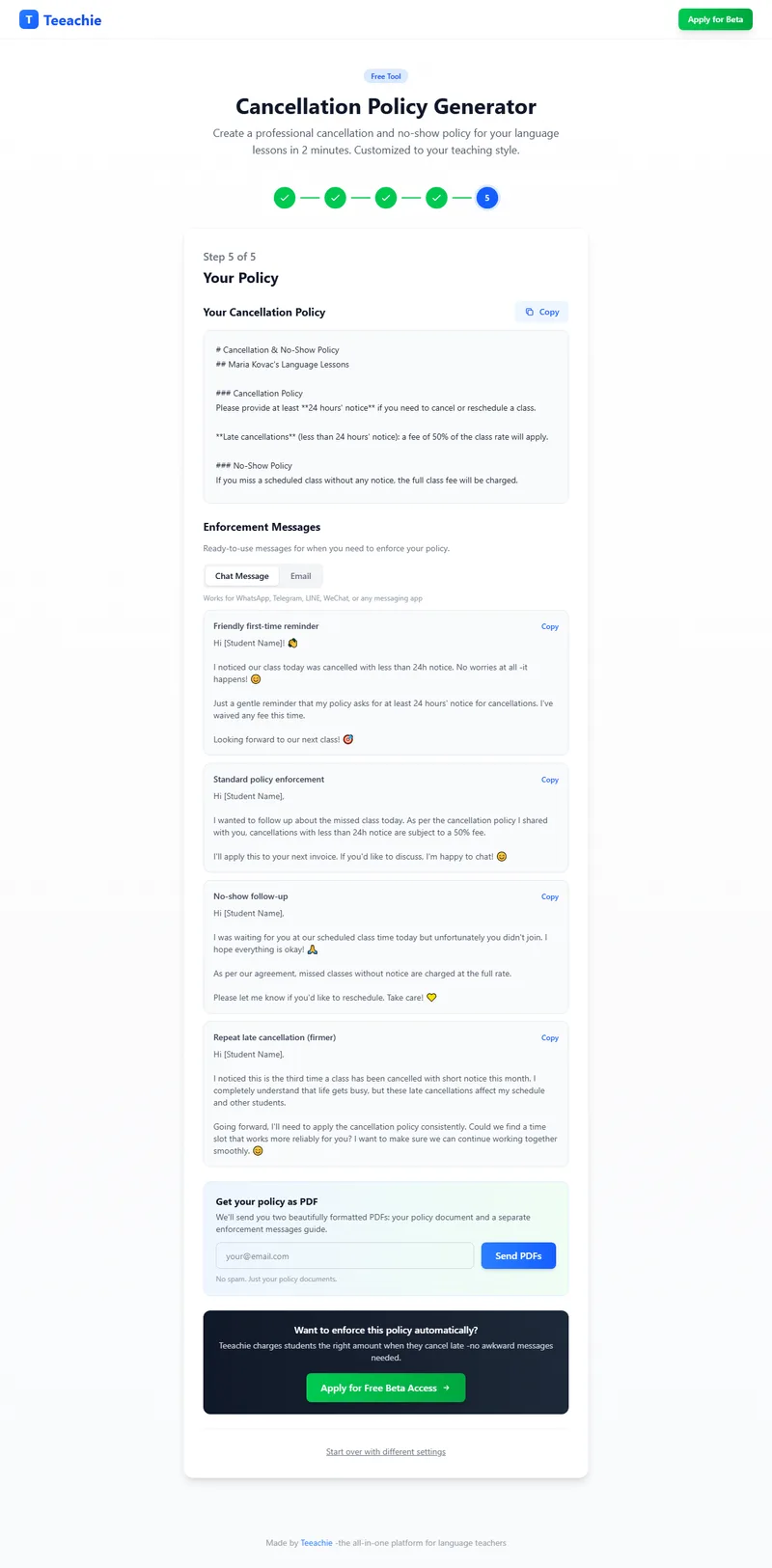
It takes about 2 minutes and you’ll have a policy you can start using today.
Want to Enforce Your Policy Automatically?
Once you have a policy, the next challenge is tracking it. Who cancelled late this month? Did you charge them? Did you remember to follow up?
This is exactly why we built Teeachie. When a student cancels late, Teeachie automatically applies the right charge based on your policy, updates their balance, and keeps a record - no awkward messages needed.
We’re currently in private beta and accepting 50 language teachers. Apply for free beta access - you’ll get 3 months free and a lifetime 50% discount.
Related: How to reduce no-shows | Handle last-minute cancellations | Message templates for teachers | Scheduling features