How Much Should You Charge for Language Lessons? (Free Pricing Calculator)
A data-backed guide to pricing your language lessons. Covers hourly rates by experience and certification, package pricing, trial lessons, group classes, and a free interactive calculator.
“How much should I charge?” is the most common question new language teachers ask. And the most common answer - “charge what you’re worth” - is the least helpful advice in the world.
Pricing isn’t about self-worth. It’s about math, positioning, and strategy. Here’s how to actually figure out your rate, based on real market data.

What Language Teachers Actually Charge (2026 Data)
Here are the real numbers based on data from major platforms and independent teacher surveys:
By experience level:
- Brand new (0-1 year, no certification): $10-20/hour
- Mid-range (1-3 years, TEFL/TESOL): $20-35/hour
- Experienced (3-5 years, CELTA): $35-55/hour
- Premium/specialist (5+ years, DELTA/MA): $55-100+/hour
By certification:
- No certification: baseline
- TEFL/TESOL (120+ hrs): +10% above baseline
- CELTA/Trinity CertTESOL: +30% above baseline
- DELTA/Trinity DipTESOL: +50% above baseline
- MA Applied Linguistics: +55% above baseline
By specialization:
- General conversation: baseline
- Kids/teens: +5%
- Academic: +10%
- Business language: +25%
- Exam prep (IELTS, TOEFL, DELE): +35%
These premiums stack. A CELTA-certified teacher with 5 years of experience specializing in IELTS prep will charge significantly more than a new general conversation tutor.
The Factor Most Teachers Ignore: Location
Your cost of living is the single biggest factor in your rate. A qualified teacher in the Philippines and a qualified teacher in London might have identical skills, but their rates will be very different - and that’s completely normal.
This isn’t a race to the bottom. Teachers in higher-cost regions offer something students in those regions value: timezone alignment, cultural familiarity, and native-level language proficiency.
The Hidden Costs That Eat Your Rate
If you charge $30/hour and teach 20 hours per week, you’re not earning $2,400/month. Here’s why:
- Preparation time: 10-40 minutes per class depending on lesson type. At 20 min average, that’s 7 extra hours/week you’re not paid for.
- Admin time: Scheduling, messaging, invoicing, follow-ups. About 10-15% of your working time.
- Cancellations and no-shows: Expect 5-10% of booked lessons to cancel or no-show. Even with a policy, not all lost time gets paid.
- Gaps between students: Your schedule won’t be perfectly packed. Realistic utilization is 65-85%.
Your real hourly earnings are typically 25-40% lower than your posted rate. This means if you want to actually earn $30/hour for your time, you need to charge $38-42/hour for the class itself.
How to Structure Your Pricing
Single Class Rate
This is your anchor price. It’s the highest per-class rate you charge, and everything else is positioned as a discount from it.
Trial Lesson
Offer a 30-minute trial at roughly 45-55% off your regular rate. This is not a “free sample” - charging something, even a small amount, filters out people who aren’t serious.
Packages (This Is Where the Money Is)
Packages increase student retention by 20-35%. A student who buys 10 classes upfront is far more committed than one paying class by class.
Standard package discounts:
- 5 classes: 5-8% off (starter commitment)
- 10 classes: 10-15% off (sweet spot - most students choose this)
- 20 classes: 15-20% off (serious students, highest retention)
Always display the 10-class package as “most popular” - it becomes the default choice.
Group Classes
Charge 40-50% of your individual rate per student. With 4 students, you earn more per hour than a 1:1 class while each student pays less. Everyone wins.
When to Raise Your Rates
- Review every 6-12 months. Don’t let years pass without adjusting.
- Raise when you’re 75%+ booked. If you’re regularly turning down students, you’re underpriced.
- Increase by 5-10%. Small, regular increases are easier to absorb than large jumps.
- Give 4-6 weeks’ notice. Honor existing package prices.
- Don’t apologize. State the new rate clearly and move on.
Calculate Your Rate in 2 Minutes
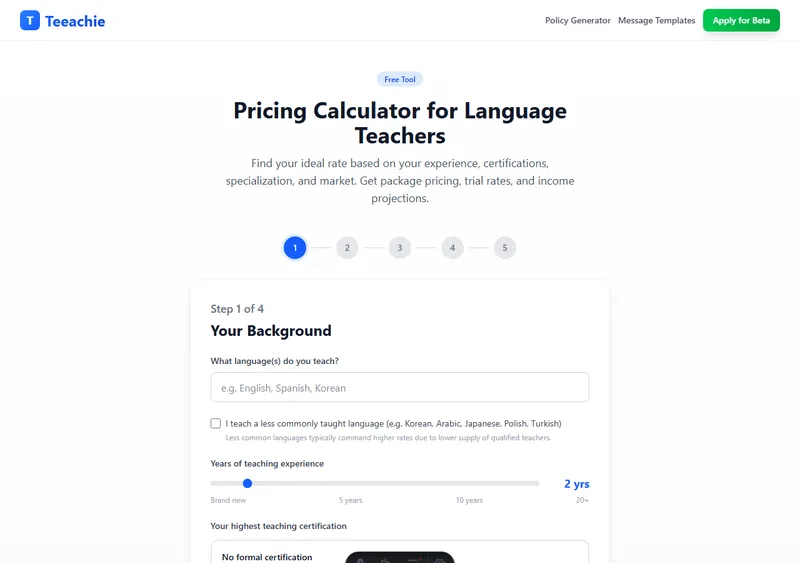
Every teacher’s situation is different. That’s why we built a calculator that factors in your specific variables.
Use the free Pricing Calculator - answer 4 quick questions and get:
- Your recommended class rate (with the math behind it)
- Trial lesson pricing
- 3-tier package pricing (5, 10, 20 classes)
- Group class rates
- Monthly and annual income projections
- Platform vs. independent comparison
- When and how much to raise your rates
The Platform Question
If you’re on italki (15% commission), Preply (18-33%), or Wyzant (25%), you’re giving away a significant chunk of your earnings. A teacher charging $30/hour on Preply keeps only $20-25.
Going independent means keeping 100%. The trade-off is finding your own students - but with the right strategy, most teachers fill their schedule within 2-3 months and never look back.
Our Business Starter Kit gives you a step-by-step plan for making the switch.
Ready to Automate Your Pricing?
Once you’ve set your rates, you need a system to track packages, send payment reminders, and handle cancellation charges. That’s what Teeachie does.
We’re in private beta. Apply for free beta access - 3 months free and a lifetime 50% discount.
Related: How to sell lesson packages | Package vs pay-as-you-go | How to price group classes | Payment features | Message Templates